Showing posts with label Fulbright Teacher Exchange Program. Show all posts

Friday, November 02, 2007

Pery, Doña Estela, and Nay, Doña Estela's helper Yesterday I spent the afternoon at Pery’s mother’s house. (Pery is my Fulbright mentor at the Centro de Idiomas here in Xalapa.) She invited me to join her and her mother in making tamales for El Día de los Muertos (Day of the Dead), November 2.

Making tamales is definitely not a project undertaken lightly. They take a lot of time, effort and skill to make but—boy, oh, boy!—they’re worth it! And Doña Estela, Pery’s mother, is a good one to learn from because of her many years of experience and her high culinary standards. She said she doesn’t make tamales often any more, but she really went whole hog yesterday, making four different kinds with the help of Pery and her household helper Nay and my meager contribution:

  • tamales de chile con pollo (chicken in a delicious sauce made of several different kinds of chiles, tomato, and other ingredients);

  • tamales de queso (two different kinds of cheese, in this case) with epizote and chiles jalapeños;

  • tamales con frijoles gordos (similar to lima beans), pepinos (pumpkin seeds heated in a pan until they puff up and turn golden), y cilantro; and

  • tamales de verduras (vegetables that in this case included carrots, green beans, potatoes, and chayote).
It was such a pleasure to spend time with Doña Estela in her kitchen, watching her work, listening to her explanations of how tamales should be made, and basking in her warmth and her dry sense of humor. Pery clearly takes after her.

The whole complex process of making tamales reminded me of preparing Thanksgiving dinner: the women working in the kitchen (it lacked the men watching American football on TV); the wonderful smells emanating from pots and pans covering every burner of the stove; and the chopping, shredding, beating, cooking, steaming, and assembling of ingredients into wonderful dishes that we wait the whole year for.

El Día de los Muertos is about more than just tamales, of course. I encourage you to read this webpage to learn about the idea behind El Día de los Muertos in México. As it explains:

The celebration goes through the night, when ‘throughout the cemetery, there is a grand family reunion of huge extended families, alive and dead, as one by one, through stories, memories and dreams, the dead return. On this night, those who wait realize the importance of living to be well remembered, working to be well respected, and loving to be well missed.’

I especially love the idea that the aromas of the tamales, chocolate, and other favorite foods and drinks of deceased loved ones tempt and guide their spirits back to their families for this one day of the year. These foods and drinks are placed on altares erected in most homes and many businesses. The altar in Dona Estela's homeIn this photo, you can see the altar in Doña Estela's home. (Pery told me she was a little dismayed that her niece had included a border with a Halloween motif--jack-o-lanterns--above the altar, but her niece failed to see a problem. Speaking of Halloween, I think the Hollywood spin on Halloween as a night of terror has changed the character of that U.S. holiday in unsavory ways since I was a kid back in the mists of time.)

I think this is a holiday my gringo family could easily embrace because we love our father, Murray King—who died at 54 in 1974—so much. If we could entice his gentle, humorous spirit to be with us even more vividly on this day than he is on other days, what wouldn’t we do? I for one would build an altar in the Mexican tradition and place on it his favorite foods (which, to be honest, only our mother could make) and drink and lots of books.

Ah, and then there are our grandparents and other dear relatives and friends we don’t want to forget and would like to draw closer to us.

I can see why this holiday is so well loved and carefully observed by Mexicans.

Thursday, November 01, 2007

Teotihuacan--Pyramid of the Sun in the background I've been to Teotihuacan [tay-oh-tee-whah-KAHN] to visit the Sun and the Moon--pyramids, that is. I took this photo of the Pyramid of the Sun in the background from a "plateau" on the Pyramid of the Moon. (Click the photo to see a larger view of this scene.)

We--the group of Fulbright teachers living in Mexico this year who met for the previous three days (Oct. 29-31) in Mexico City--climbed both pyramids on Tuesday. I can still feel the effects of the climb in my leg muscles.

Before we went to the site, we were given a short demonstration of how indigenous people used--and still use--the agave plant to make pulque, mezcal, tequila (a particular kind of mezcal), needles, thread, paper, fiber for making clothing and for other uses, and I forget what else.

I was fascinated to learn about this versatile plant and the ingenuity of the indigenous people who made use of every part of it. I have an agave plant in my front yard in Albuquerque, and now I appreciate it even more.

Sunday, September 23, 2007

This past week, I've been a guest presenter in other teachers’ classes at the Centro de Idiomas, talking to the students about New Mexico and the U.S. and giving students a chance to interact with a native English speaker. It’s been fun to talk with students and to hear their questions. In several classes, students have asked about the UFOs sighted around Roswell and whether I believe in UFOs. Students are interested in the Albuquerque Balloon Fiesta when I tell them about it, and they have questions about the Trinity Site where the first atomic bomb was exploded (“Is there a big hole there?” “Is it still radioactive?”).

But some students have asked harder questions, like “What do you think about the wall your country is building on the border?” Then there is the fact—no news to them—that the land that is now New Mexico used to belong to México until the U.S.-Mexican War and the sale of a large parcel of land (called the Gadsden Purchase in the U.S., the Venta de la Mesilla here in Mexico) made it U.S. territory. These events were the beginning of the conflicted relations between Mexico and the U.S., and they continue to be conflicted today.
----

During one of my classes in which we were talking about intercultural communications—which involves a lot more than simply speaking the language of another country—I asked students to describe the stereotypical American. “Go on,” I said, “I can take it.” And here’s the description I got:

  • cold
  • rude
  • impatient
  • thinks s/he’s better than other people.

I took the opportunity to give one possible explanation for people from the U.S. being perceived as impatient—outside of the possibility that many of us are in fact impatient people, used to fast, automatized service—by explaining that in the U.S., we are accustomed to waiting in lines to be served, and the rule is “first come, first served.” Anyone who cuts into the line or pushes to the front is quickly castigated and sent to the rear.

I witnessed a vivid example of this rule in action when I was standing in line to board the plane from ABQ to Dallas on my way here. The lines were long, and as I approached the X-ray machine to have my carry-on luggage scanned, a man hurried up to one of the security people and evidently asked to pass through security ahead of the line because he was about to miss his plane. In a loud voice, the official told the man, “Only if you want to ask each one of these people in line if you can go ahead of them.” Since there were probably 200 of us in line, this would hardly have sped him on his way in time to make his plane. Frankly, I would have let the guy through, but the security official clearly took the “first come, first served” rule seriously.

But in Mexico, the rule is different. I have been at pharmacies and supermarkets where people pushed ahead of me or stood beside (not behind) me and began talking to the clerk even while I was being helped. And the clerk has stopped and responded to that person while I waited. With the “first come, first served” rule ringing in my head, I would have been tempted to inquire, “Who is being impatient in this case—me or the person who demands the help of the clerk while I’m being helped?”

Thank goodness I had been prepared for this situation during the Fulbright Teacher Exchange Program Orientation last August, or I might have responded as an “impatient” American: “Excuse me. I was first in line. Please wait your turn.”

Craig Storti’s presentation on “The Art of Crossing Cultures” was the highlight of the orientation for me not only because he was such an engaging speaker but because what he said and demonstrated and had us role-play has been so useful to me ever since—to wit, the cultural rules I’ve grown up with are merely my culture’s rules. Other cultures go by other rules. We grow up believing strongly that our rules are the right way to do things, but in fact they are simply our way of doing things. The rules that people from other cultures act on aren’t necessarily wrong, only different.

In Mexico, the rule is that everyone gets a little help, a little service, at the same time. No one is ignored. Each person’s needs are important, and in fact some people’s needs just might be more important than others at a particular point in time.

That’s why intercultural communication is so complex—because it involves understanding the unspoken rules of the culture which govern people’s behavior.

And lest I leave the wrong impression, in many large stores where there are long lines, Mexican people wait in line without jumping ahead. But when the line is short, the other rule seems to apply.

Saturday, August 25, 2007

Imagine you're a teacher on a Fulbright Teacher Exchange, going to another country as a representative of your college and your country. You want to make a good impression, especially on the first day of classes. You want your colleagues and your students at the new school to respect you for the professional that you are. No pressure though.

Okay, now imagine the day from hell. Well, maybe that's a little strong. Imagine a day from purgatory. Even that's a little strong. Imagine an hour of purgatory. I think I’ve exercised your imagination long enough. Here’s what actually happened:

Last night, I prepared for the first day of classes by setting out my clothes, getting the coffeepot ready to go, putting my books and supplies in my bag, and setting my new alarm clock. Yes. I set my new alarm clock for 5:45. I wanted to get there early. And, of course, you can already guess that that alarm clock didn’t go off. No. Instead, I woke up to a deep silence. The light in my bedroom was still subdued, so I thought I had wakened before the alarm went off, but I looked at my watch just to be on the safe side: 7:52 a.m. Eight minutes to 8:00! Eight minutes to get to my first class on time! But I knew that it was impossible. After all, Isabel had told me that the school was 15 minutes on foot from my apartment.

Luckily, I had my new cell phone, which I had bought mainly to contact the school in case of illness or some other catastrophe. So I called—or, rather, attempted to call—the Centro de Idiomas. But instead I got a message in Spanish that I wasn’t able to interpret although it was clear that for some reason my call wasn't able to go through.

There was nothing to do but to throw on my clothes, run a brush through my hair, swish my mouth with Scope, grab my bag, and get to school as fast as I could. The walk is all downhill so I was able to go fast. In fact, I arrived at the school and walked into my classroom at 8:08 by the time on my watch (which I keep 2 or 3 minutes fast). Whew!

My students were there, 14 of them, sitting quietly in their seats, as I rushed into the room. I introduced myself as their teacher and apologized for my lateness. I gradually recovered my composure and got down to the business of explaining the contents of the course and how their speaking, listening, reading, and writing skills would be evaluated. (At the Centro de Idiomas, students don’t receive a printed syllabus; instead, the instructor goes over the programa with the students orally and answers any questions they have.)

At that moment, a cell phone rang, and I took the opportunity to ask students to always turn off their cell phones in class. But no one moved to turn off the ringing phone. I decided I needed to demonstrate what I was asking them to do, so I pulled my phone out of my pants pocket and held it up for the students to see. R-r-ring! OMG! That ringing phone was mine! I looked at it as if it were a rattling snake. I didn’t know how to turn it off—I just got it, remember—but luckily it stopped after a few more rings.

What could I do but laugh at that point? It was becoming a comedy of errors. The students began to laugh good-naturedly, too.

The situation reminded me of a workshop I attended once in which the presenter showed how she deliberately demonstrated bad classroom behavior at the beginning of the first class of a term—arriving late, chewing gum loudly, eating a roll, drinking coffee, taking a phone call in class, seeming not being prepared—as a roleplay to start a discussion with students on what kinds of behavior should and shouldn’t take place in the classroom. I was also reminded of my seventh-grade teacher Sister Olivia’s grave warning to her students: that some of us would serve as bad examples for the rest.

At that point, a student knocked on the closed classroom door and asked politely for permission to enter. (This is what students do in Mexico, unlike in public schools and universities in the U.S., where they are taught to enter as unobtrusively as possible--although the unobtrusive part sometimes gets overlooked.) I certainly wasn’t in a position to deny his request nor admonish him for being late, even if I’d been inclined to do so. I ended up saying to him and the class that, beginning Monday, we should all do our best to arrive on time. And then we got down to work.

The rest of the day went well. The students in both of my classes were polite and friendly and seemed eager to learn English. I found out that my phone call during class had come from Pery, who was worried about me when I didn’t show up at the school on time. I also found out that the reason I couldn't make a call on my cell phone was lack of air time. When I bought the phone, I thought I was getting 300 minutes of air time free as part of the purchase, but in fact, I received 300 pesos (about 60 minutes) of air time--the first 100 pesos disbursed at the time of the purchase, and 100 pesos made available at the beginning of the next two months.

I ended up staying at the school all afternoon. I talked with Gabi and Rosa Elena from the Self-Access Center, where I will be involved in helping with “conversation clubs” and reviewing some of the learning materials developed there as additional resources for students. I also worked on plans for Monday’s classes and talked with some of the other English teachers who showed up at the faculty computer room. I was getting ready to leave when I heard the sound of heavy rain coming through the open door of the office. I ended up waiting about 30 minutes for the rain to stop so that I could walk home.

When I got back to my apartment at 5:48 that evening, I could hear my new alarm clock ringing as soon as I opened the front door.

Tuesday, April 10, 2007

Yesterday afternoon, I met with Sally Pearson, CNM vice president of academic affairs, as per the instructions I received in the information packet from the Fulbright Teacher Exchange Program. I found out she'd already scheduled a meeting with my dean, Gerry McBroom, for this Wednesday, and at that time, they'll determine the appropriateness of my proposed exchange partner. Once [if] they agree Isabel Gonzalez-Macias is a good fit for CNM, I can contact her and start preparing to live and teach in Xalapa, México, for a year--assuming that the administrators at Universidad Veracruzana deterimine that I would fit well there as well.

Then yesterday evening, I met Sherry Holmen and her husband Lyle and kids Luke, 17, and Megan, 8, at Padillas' Restaurant to pick their brains about living outside the country for a year. Sherry has had two Fulbright exchanges, both to Great Britain. My two big questions to them were (1) how do I get ready to leave the country for a year? and (2) what do I take with me?

The Holmens exchanged houses with Sherry's exchange partners in both instances, so they didn't have to take household goods with them. I don't know if that will be the case for me. The Fulbright information says that housing exchanges in México can be "difficult" in part because Mexicans typically live with extended family members, which--I'm inferring, based on my own concerns--may not meet the privacy needs of folks from the U.S.

I plan to follow Luke's advice on what to take: pack as if for a long vacation. I had imagined (without thinking it through) that I would need to send boxes of household goods and appliances to myself in México, but not so. Duh. If I need stuff, I can buy it there.

Sherry said something especially interesting--that I should be prepared to experience culture shock on my return to this country. She said she had at least as much difficulty re-entering the U.S. culture as leaving it, an unexpected reaction that hit her on her second day back, in Walmart where she'd driven after having not driven a car for a year in England.

All of the Holmens agreed their time abroad was a great experience and lament that they have few outlets for their stories of adventure out of the country. Friends and colleagues who haven't had a similar experience of living or traveling outside the country often can't relate. "After about five minutes," Lyle said, "their eyes just glaze over."

And finally, Sherry, Lyle, Luke, and Megan encouraged me to approach my exchange with a spirit of adventure and open-mindedness. They assured me that I'll make cultural mistakes but will be forgiven for my ignorance.

Friday, April 06, 2007

My friend Anne Bryson, visiting from Philadelphia, and I were eating breakfast at my dining room table this morning when I spied a Fed-Ex truck parking in front of my house and a moment later the guy bringing a small rectangular package to my door.

When I opened it, I found a familiar-looking manila envelope with a familiar-looking address in the left-hand corner: Fulbright Teacher Exchange Program. Hallelujah! Another proposed exchange, again in Mexico! I thought I would have to wait much longer--and perhaps wait fruitlessly--for another possible exchange.

This time I knew what to do to find out the location of the proposed exchange: I called the office of the Vice President for Academic Affairs at CNM and asked Louise Scherffius, executive secretary, to see if a Fulbright packet had been received in the President's office. She called me back a couple hours later to give me the news: the proposed exchange location is at the Universidad Veracruzana in Xalapa, Veracruz!

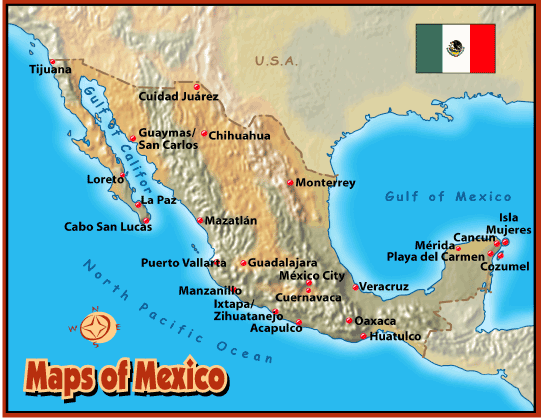
I quickly googled "Xalapa Mexico" and found its location on a map: 64 miles west of Veracruz, a port city on the Gulf of Mexico, and 187 miles east of Mexico City. It's a university town (three of 'em) with a population of 387,000 as of the 2000 census. (Read more about Xalapa on Wikipedia.) My exchange partner teaches at the Centro de Idiomas, Universidad Veracruzana, in Xalapa.

Xalapa sounds wonderful to me! Now I must wait and see if my exchange parnter's school and mine agree that the exchange would be beneficial to both institutions.

I'm trying to restrain myself from running down the halls and shouting the news. But it's Good Friday afternoon, so there's hardly anyone here on the fifth floor of Max Salazar Hall to share my good news with anyway.

Friday, March 23, 2007


A week and a day since receiving my notice of a possible Fulbright exchange partner in México, I still don't know where in México I might be headed. But I did receive a phone call from Sonia at the Fulbright office in DC this morning, returning my calls of yesterday, to let me know that the packet of information containing the crucial details of my life and fortune in the coming academic year was sent to the office of CNM's president, Michael Glennon, instead of to the Academic Affairs Vice President's office. So I called Louise Scherffius, the vice president's executive secretary, and she volunteered to walk over to the president's office and get the packet. Surely I'll find out today where I'll be living and teaching.