 Last Friday night, Oct. 5, I went with Margarita and a friend of hers, Genoveva, to an outdoor show of Cuban dance put on by a Xalapa dance troupe, Xalhabana, and then we went out to eat at an Italian restaurant whose name I now forget.
Veva is a woman of many talents—a businesswoman who also has a law degree but prefers business to a law practice. She has been in the car windshield business (originally her father’s) for over 20 years and more recently has started a car rental business. I enjoyed talking with her and hearing her many stories.

After I got home, Margarita called and asked if I wanted to go Veracruz her, Miriam, and Veva, her two sons the next day. I said yes, of course. I hadn’t spent time in Veracruz except to arrive at the airport there back in August.
So at 9:30 the next morning, Veva picked me up in her van. Her sons Ariel, 15, and Bruno, 11, were in at the back, Margarita and Miriam in the middle seat, and I sat in front with Veva on the way to Veracruz. The kids watched a movie on the van's drop-down screen while the adults talked. Veva knows quite a bit of English and is interested in learning more, so we talked in a mixture of English and Spanish.

Our first stop was at the aquarium, which Veva told me is one of the top aquariums in Latin America. (Its
website is impressive, too.) As soon as we got out of the van, the sultry air of Veracruz enveloped us. What a difference between the heat of Veracruz and the temperate climate of Xalapa! The aquarium, however, was air-conditioned.

Next, we went to the fortress of
San Juan de Ulua. I was really impressed, amazed, and appalled by it and its long history. It was built in 1565 and served as a fort, a customhouse, and—in the 1800s—

a prison that must have been like hell on earth. It was also the site of the filming of some parts of
Romancing the Stone in 1984, according to Wikipedia.
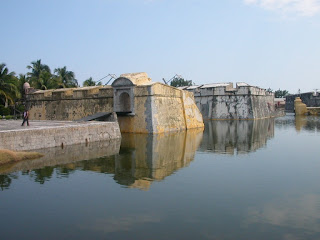
We took a tour that included dungeons and prison cells that once held some of Mexico’s worst criminals and many political prisoners, including
Benito Juárez. One prisoner seemed well-known to the others on the tour: Chucho el Roto, a Mexican Robin Hood in the 1800s who eventually escaped.

I can’t imagine how horrible life must have been for prisoners there. For one thing, the cells and dungeons were dark, with elongated slits in the rock walls for ventilation. And they were dank. Rain seeped through the ceilings and walls, and at times the sea rose, causing flooding in the cells themselves. (You can click on the dark photo I've posted here and barely make out the stalactites growing from the ceilings--and there are stalagmites rising up to meet them on the rock floor.)
In some dungeons, “Chinese” water torture was inflicted on prisoners shackled to the walls. And I can only imagine the rats and insects that must have lurked there. Our tour guide told us that at one time, the moats around the prison were stocked with sharks, eliminating the need for a cemetery when prisoners died there.

After the tour, we went to a restaurant in Boca del Rio, a small city adjacent to Veracruz, and there we had seafood. I had some tasty fish while Veva and her sons had large shrimp cocktails. I think Margarita had chicken, and Miriam had her favorite meal:
papas y pollo—French fries and chicken. A musical group was playing tropical music when we arrived, and from time to time, they would rest, and other musicians and
Jarocho dancers dressed in their traditional white garb would stroll among the diners and perform.

We left the restaurant and headed for the beach, or rather, for the promenade along the beach where we joined hundred of Veracruzanas sauntering there. It was a great way to walk off our food and to people-watch at the same time.

Here's a sculpture that I admired--but I didn't get the name of the piece or of the sculpture, I'm sorry to say.
If anyone knows the name, please let me know.
Our last stop in Veracruz was at La Parroquia, a popular restaurant close to the beach where we had drinks. Veva, an avowed coffee lover, had cafe lechero served ala Parroquia: strong coffee served in a glass by one waiter and filled up with hot milk by another waiter--called to the table by tapping one's spoon on the glass. This waiter came with a pitcher of steaming milk and poured with a flourish, beginning high above the cup, bringing the pitcher down toward the lip of the glass, and then raising it up, creating lots of foam in the glass. It's quite a daring performance, maybe more daring for the customer than the waiter. At any rate, Veva said it was wonderful coffee. Since it was evening, I declined coffee in favor of bottled water, but I'll have to try it another time. I definitely want to return to La Parroquia and to Veracruz.
We left the restaurant around 8:00 p.m. and headed back to Xalapa, about an hour away, making one last stop for some ice cream. I had lime sherbet. And on the way back, I sat in the middle seat listening to Veva and Margarita talking and trying to keep up with their conversation.
All in all, it was a good day.
Oh, and in Veracruz I discovered something--thanks to a monument to Jose and his father Manuel Azueta--that I'd never learned in any of my history classes: that the U.S. attacked and occupied Veracruz for six months in 1914.
Here's the United States' version, and
here's another version of that event.

 Last Sunday, October 14, I went with Margarita and Miriam to the Teatro del Estado (state theatre) to see a show of folkloric dance by the Ballet Folklórico de la Universidad Veracruzana in celebration of its 43 anniversary. The show, “Homenaje a Veracruz” (homage to Veracruz), featured folk and modern dances from several regions of Veracruz, a state that stretches north and south along the Gulf of Mexico.
 The range of dances spanned eons as well as geographical regions, depicting dances and costumes from prehispanic, colonial, and modern times. The production was so well done—directed, staged, costumed, and danced—that it reminded me of Broadway productions I’ve seen.
 One of the dancers, Elsa Malpica Muñoz, is an English teacher at the Centro de Idiomas. In fact, she was the one who told me about this event, and I’m so glad she did. As I watched, I felt like I was getting a Mexican history-and-culture lesson in the most enjoyable way--through dance and music.
 One of the dances that most fascinated me was the “Danza de los moros y españoles”—dance of the Moors and the Spanish. As near as I could tell, the dance reenacts fighting between the Moors and the Christians in Spain. The “Moors” and the “Spanish” dancers clacked long sticks together in ritual sword-fighting—art imitating life and transforming it into beauty.
 The dance of “la bruja” (witch) was particularly beautiful and--well...bewitching--to watch: the lights were turned down, and the women in long white jarocha dresses danced gracefully by the ghostly light of candles balanced on their heads and held in their hands.


