As you can see from this photo, the Tio Yeyo rises modestly among trees, flowers, flowering trees, grass, and wild flowers, and a stream that requires a foot bridge to reach the restaurant.
Sunday, July 20, 2008
As you can see from this photo, the Tio Yeyo rises modestly among trees, flowers, flowering trees, grass, and wild flowers, and a stream that requires a foot bridge to reach the restaurant.
Sunday, July 13, 2008
On the way to the beach, La Mancha, two weekends ago, June 29, my guides--four fellow English teachers at the Centro de Idiomas--and I stopped at a restaurant in Rinconada for brunch.
In the photo above, Gregorio, José Miguel, Luís, and I are posing while Janeth takes the picture. Just behind our table, women are working over a large comal to make fresh garnachas--which we ate with gusto.
Then we piled back into Gregorio's VW and headed for the beach. The ocean water felt cool when we first inched into it, but it soon began to feel just right. The sky was overcast for the most part, so it wasn't too hot--but I found out that night that it didn't
prevent me from getting a bad sunburn. (Yes, I did put on sunscreen, but I should have reapplied it periodically.)
After three hours or so, we gathered up our stuff and headed toward La Antigua for something to eat and to visit the first chapel built in America. Here we are in a riverside restaurant where a tropical band was playing when we first arrived.

Then we went to see the first chapel in America, built by Spaniards in 1523. It is a small building, still in
use, well maintained. To test the acoustics, José Miguel sang some Gregorian chant, remembered from his childhood, that filled the whole chapel.
Read about La Antigua on this blog (scroll down about one-fourth of the way) to learn more about this chapel and see better photos than mine here.
Posted by
Nancy King
at
1:58 PM
0
comments
Labels: Centro de Idiomas, garnachas, Gregorian chant, La Antingua, La Mancha, Veracruz
Saturday, July 05, 2008
Last night on the “glorious 4th” (Independence Day in the United States) I was invited by fellow English teacher Laura González to a concert of the Xalapa Symphony Orchestra with Tania Libertad, a singer I had never heard of before—although she is well known here in México. Peruvian by birth, she’s lived in México for many years. (Here you can read about her and sample her voice, but the samples really don’t do justice to the power and range of her vocal abilities.)
It was a wonderful evening—and not just for Libertad’s beautiful voice and impassioned interpretations but for the symphony orchestra, directed by Fernando Lozano, as well. For one thing, watching Lozano—a tall man in the tercer edad (the third age) as they say here—was a pleasure in itself: his gray hair clearly styled by a protégé of Einstein’s hairdresser, his directing at times an elegant dance, at other times a pounce, sometimes languid, sometimes lively, always interesting to watch.
Here is a list of the music I heard—and I write it down here so that when I return, I can begin to acquire some of it. If you’re not familiar with it either, dear readers, I encourage you to try it out.
The orchestra played two pieces of music before Libertad came on stage for each of the concert’s two parts: “Conga del Fuego Nuevo” and “Danzón,” both composed by Arturo Márquez. I loved them both.
Libertad sang these songs:
- “Mañana de carnaval” (Luis Bonfa)
- “Placer de amor” (Schwarzendorf)
- “Rival” (Agustín Lara—a Veracruzana, incidentally, and much loved here)
- “Los pájaros perdidos” (Astor Piáosla)
- “La Guinda” (Edusebio Delfín)
- “Cuando sale la luna” (José Alfredo Jiménez)
- “Caruso” (L. Dalla)
- “Noche de Ronda” (Agustín Lara)
- “Himno al amor” (M. Mannote)
- “Piensa en mi” (Agustín Lara)
- “Syboney” (Ernesto Lecuona)
And for an encore, demanded by the audience with chants of “Otra! Otra!”(Another! Another!), Libertad sang Schubert’s “Ave Maria” and—a cappella—“Alfonsina y el mar,” an especial favorite of the crowd.
After the concert, Laura gave me a ride home, but we didn’t get far from the concert hall for about a half hour because of the huge line of cars exiting the Universidad Veracruzana campus. So she parked her car at the top of a hill overlooking the hilly city of Xalapa, the view softened by a thin fog. Around us were palm trees and araucarias (a native evergreen tree) and the tall grass fed to exuberant heights by the rains that have fallen during this rainy season. We lowered the windows to enjoy the cool night air and take in the sights better. We could see far away on another hill in the center of the city the cathedral, clearly lit, a beacon on a hill.
--
Back to the topic of the United States' Independence Day, July 4, readers who haven't been to the U.S. might be interested in learning how we celebrate this day. You can find a smorgasbord of information, articles, and photo slideshows of this year's celebration on the New York Times website. Also, have a look at "A Taste of Independence," an article that talks about what people traditionally eat as they celebrate this day--and how immigrants to the country have added their own twists to these traditions.
Posted by
Nancy King
at
11:46 AM
0
comments
Labels: 4th of July, Agustín Lara, araucarias, Director Fernando Lozano, Tania Libertad, Xalapa Symphony Orchestra
Monday, June 23, 2008
On Thursday night, after a six-hour bus trip, I arrived at the bus terminal and took a taxi to the Hotel Calinda Geneva located in the Zona Rosa, an area close to Mexico City's historic center. It’s also the gay district and offers tourist a lot of shopping and restaurants.
On Friday, Brenda took me to see some of Diego Rivera’s murals. We got our big disappointment of the day out of the way quickly: we’d gone to the SEP (Secretaría de Educación Pública) building to see the three floors (!) of Rivera’s murals displayed on the walls there, but we were turned away by guards who said the building was closed and wouldn’t be open to visitors again on Monday—alas, we’d be gone from Mexico City by then. Brenda told me that the last time she’d tried to see the murals several months ago, guards had told her the same thing.
But onward and upward. Next, we headed for the Palacio Nacional, an historical building where Hernán Cortez once lived and where Mexican presidents have an office, at least nominally, for formal occasions. It’s also the building where the president gives the grito (in remembrance of Miguel Hidalgo’s grito, or battle cry in 1810) on September 15, on the eve of Mexico’s Day of Independence from Spain. September 15 is actually the day its war for independence began in 1810. It wasn’t achieved until 1821.
One of Rivera’s murals in the National Palace spans the three walls that rise above the double staircase leading up to the second floor. Brenda and I stood on the second floor landing to view this epic depiction of Mexico’s history and Rivera’s vision of a socialist state in which, finally,
Mexico’s poor and indigenous people would rise to the level of their deserving. To read more about this mural, click on these links:
Center wall
Left wall
The mural—and all the other murals covering the walls on the second floor of the palace—deserved much more time and study than we gave them. Brenda had seen these murals before, and she helped me see certain details that I probably wouldn’t have noticed or understood without her help. And she herself noticed new details that she hadn’t discovered before. The paintings are so rich in history and symbolism that, I think, if I could take in everything they contain, I’d understand Mexico’s history and culture in great depth.
Next we went to the Museo Mural Diego Rivera, which houses “Dream of a Sunday Afternoon in Alameda Park,” one of his most well-known murals. In fact, the museum was built to display this one mural. It covers one whole wall, and in front of it, at viewing distance, a line of armchairs and two comfortable couches invites people to sit and study it. Brenda, again thegood guide, helped me identify some of the people in the mural, and I had fun trying to figure out the identities of others on my own. Rivera wasn’t a bit subtle in his depictions of the good and the bad guys. Still, I know I missed a lot by not knowing more about Mexican history and culture.
I was intrigued by Rivera’s death mask and a sculpture of his hand—actually, I think it was a mold—displayed at this museum, too. The face and the hand showed that he was a smaller man in the flesh than I had imagined him to be. Perhaps I was misled into thinking he was a big man by the photos of him with Frida Kahlo, who must have been petite, judging from her tiny torso brace that I saw the next day hanging in her museum, the Casa Azul. Certainly Rivera was big around the waist and big in artistic stature, but if the mask and sculpture are to be believed, he wasn’t big-boned.
Behind the sofas and chairs were two maps of the mural—one in Spanish, one in English—with all the outlined figures numbered to help viewers identify them and learn a little about them and their relevance in the scheme of the mural.
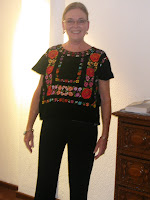
After we left, we did some shopping in nearby stores featuring the work of Mexican artisans—Brenda bought a beautiful top and a turquoise bracelet, shown here—and then we headed to the Museo Dolores Olmedo Museum. Dolores Olmedo was a wealthy woman who was also a friend of Frida Kahlo and Diego Rivera (as well as his model and probably his lover at some point; Rivera was a notorious womanizer). Olmedo shared Kahlo and Rivera’s political views, and when she died, she gave her lovely home and fabulous art collection to the Mexican people.
The grounds around the house are beautiful—large expanses of green grass, flowers, trees, sculptures of Juan Soriano, and peacocks ambling around. Mexican hairless dogs are also kept there, the same breed whose image appears in all of Diego Rivera’s murals. This breed dates back to the time of the Aztecs.
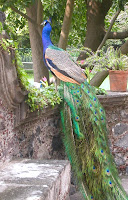
Although visitors are allowed to take photos of the museum grounds, unfortunately photos aren't permitted to be taken inside.
The rooms of the house are divvied up between those devoted to Kahlo’s art and those devoted to Rivera’s. Interspersed among the paintings in each room are prehispanic sculptures and religious artifacts as well as religious icons of Spanish origin.
I was especially interested in a painting—Diego Rivera’s last—of watermelons after Brenda told me that Frida Kahlo’s last painting was of the same subject—watermelons—on which she inscribed the words Viva la Vida ("Long live life"). The fact that Kahlo was in pain much of her life, to me, gives those words a triumphant and defiant ring. And did Rivera make a conscious choice to echo her last creative act? Surely he did, joining her in affirming life--and also affirming her--by using the same symbol.
---
Brenda had to leave Mexico City the next day early in order to make her flight back to the U.S. at 7:00am. I woke long enough to see her off, and then I went back to bed. When I woke later at the civilized hour of 9:00, I dressed and went to the Starbucks on the corner to get coffee and a sandwich for breakfast. Then I walked two blocks to the nearby subway station (Insurgentes) to get to Coyoacán, an artist community/suburb of Mexico City where Frida Kahlo grew up and died, and where Trotsky and his wife Natalie lived for several years—and where he was assassinated.
It wasn’t easy to get to the Casa Azul, the house (and now museum) where Frida Kahlo was born and died. From the guidebook I was using, I knew I’d have to take a pesero (a bus) from the Metro station to a bus stop on a major street, and from there I’d have to walk or take a taxi.
So when I emerged from the Metro, I asked directions of several people, none of whom knew the street I was looking for. Then I asked a woman who told me to board a certain pesero across the street from where we were standing. I crossed the street and waited for that particular bus—and another helpful woman asked the driver of a bus that she thought was the right one if his bus was the one I needed, and he said it was. (This same woman told me a Mexican dicho that I don’t want to forget: “Preguntando, se llega a Roma.” ["By asking questions, one arrives in Rome.”])
So I boarded—only to find out a couple miles down the road that the bus driver had thought I was looking for the Coyoacán Metro station, not the suburb. So I got off the bus and backtracked partly by foot and partly by Metro to my original stop, where I started over again. I reflected on the dicho my helper had told me not long before--Preguntando, se llega a Roma—and I decided that the saying was still true, but I realized one might have to travel through Singapore first.
This time I asked a zapatero (I’m not sure this is the correct word in Spanish), a shoe-shine guy located outside the Metro stop, and he told me where to find the correct street corner to find the correct pesero. Whew! Soon I was walking along Calle Tres Cruces heading toward Casa Azul.
Along the way, I ran into a used bookstore, Librería Tres Calles, which looks more like a book warehouse than a bookstore. I felt like I’d stumbled into heaven. I found a large section of books in English on the second floor, where I chose a few books for my friend and fellow English teacher Luís Méndez, who has been so generous about lending me books in English from his personal library over the past year. (I typically read the newspaper and books in Spanish in the afternoon, but before I go to sleep at night, I like to read in English.)
Then I forced myself to leave the bookstore—I could have spent hours there—and pressed on to the Casa Azul. And it was worth wrenching myself away from the books.
Fast forward: This weekend, I watched the movie Frida that another English teacher here, Josefina, lent me, and I was delighted to see in the first and last scenes of the movie the same Casa Azul I saw last weekend. In the movie, I saw scenes that included the Mexican hairless dogs, the Pyramids of the Sun and the Moon at Teotihuacán, Frida’s bed with a mirror overhead that allowed her to paint some of her self-portraits, and a cast and back brace that she wore at different times in her life.
One of the most startling and poignant sights in the Casa Azul, for me, was Kahlo's tiny bedroom whose windows and the door on one wall look out onto the patio in the center of the museum that was once her home. I could imagine that she needed to be able to look out and see sunlight, trees, and flowers from that tiny room where her many operations imprisoned her. Now, on her single bed, there rests a black death mask of her face, surrounded by a rebozo that gives the illusion of covering her hair and neck. If you click on the photo here, you can see a larger although blurry image. Next to the pillow, you can see the death head, and at the foot of the bed is a plaster torso cast Frida once wore.
I also saw her last painting, the watermelon-Viva-La-Vida painting in one of the rooms of the house that serves as a gallery. Because it isn't permitted to take photos inside the house, I took the photos of Frida's bedroom and the watermelon painting from outside.
When I left the Casa Azul after spending about two hours there, I walked the six blocks or so to the house where Trotsky and his wife lived after they fell out with Diego and Frida—but not before, it’s said, that she and Trotsky had an affair.
Trotsky’s house intrigued and touched me even more than Kahlo’s. The museum made it clear that Trotsky was very much in danger from Stalin—and the movie Frida provides a scene in which Trotsky tells Frida that four of their—his and Natalie’s—children were hunted down and killed after he fled Russia. Two attempts on his life were made in Mexico, one unsuccessful—that left gouges in the bedroom walls, visible still, where he and his wife escaped death by ducking into a corner next to the window where Mexican artists/Stalinists attempted to shoot him. The second attempt successfully ended his life. He was killed by an axe for cutting ice that was plunged into his skull by a Stalin supporter who gained entry and acceptance in the house by wooing one of Trotsky’s secretaries.
I saw Trotsky’s study and his library, and I saw the papers on his desk that were there on the day he was killed. (He was writing a book on the life of Stalin that he never finished.) I saw the cot in that room where he rested when his headaches became acute—he suffered from high blood pressure. I saw the dictation machine he used to dictate his book to his secretaries, and I saw the rabbit hutches that held the rabbits he cared for himself and some of the cacti he gathered from the nearby Mexican hills to decorate the garden of his home. And I saw the hammer-and-sickle symbol that crowns the concrete monument marking his and his wife’s grave in the garden of their Mexican home. Unfortunately, I ran out of space on my camera's memory card right before I entered the house, so I wasn't able to photograph any of it. The photo here shows the Trotskys' house with the garden in the foreground and the monument marking their graves.
It was almost 6pm when I left to return to the hotel by Metro.
A note: taking the subway in Mexico City is an adventure in itself. It is easy to navigate and cheap—2 pesos, or 20 cents US—to get around in this huge city of 20 million (or more) people.
Unfortunately, some of these people take advantage of the captive audience. On almost every stop, a new vendor will board the car and try to sell pirated CDs or DVDs by playing them on portable players, with the volume turned up LOUD, strapped on his/her person. Beggars and the disabled also use the Metro to ask for limosnas (charity). I enjoyed and gladly paid to hear a blind guitarist sing and hear his impassioned song as he moved slowly and unsteadily through the car.
Then there are those who bring theatre or, more correctly, the carnival to the Metro. Brenda had already told me about these guys, thank goodness, so I wasn’t quite so shocked as I would have been otherwise. Here’s what I witnessed twice: a young man, shirtless, entered the car while carrying his shirt like a sack. His back was scarred, and this is why: He lay his shirt in front of the doors of the subway car revealing the broken glass of beer bottles. All the while he was talking like an announcer or a barker. Then he moved away from the broken glass and—with a quick turn—made a gentle somersault, landing on his back in the broken glass.
The crunch of it made me flinch the first time.
But with hardly a pause, the young man rose and enfolded the glass in his shirt again. And then he walked throughout the car with his hand extended, asking for money. And although his back had red marks on it, there was no blood, probably because of all the scar tissue he'd built up over his career.
I didn’t give the young man anything either time because I didn’t want to encourage him to continue to make his living thus.
---
I left Mexico City on Sunday afternoon, taking the bus back to Xalapa. It took only five hours to return (six hours to arrive), and it was good to get back home as usual. But I would love to return to Mexico City one more time before I return to Albuquerque on July 31.
Posted by
Nancy King
at
3:20 PM
1 comments
Labels: Casa Azul, Diego Rivera, Dolores Olmedo, Frida Kahlo, Leon Trotsky, Mexico City
Wednesday, June 04, 2008

I wrote about my mother on Mothers Day, May 11, but I didn’t write about what I did on Mexico’s Mothers Day, which falls on the same date--May 10--here every year. This year, May 10 fell one day before Mothers Day in the U.S.My fellow English teacher at the Centro de Idiomas in Xalapa,
Gregorio, invited me to have dinner with him, his mother, his sisters, and other family members on that day. I found out that all of the members of his immediate family are teachers at different levels of education--including his mother, who is a retired teacher.La comida was served on the patio where tables were set up under a canopy and umbrella to shield against the early-afternoon sun. I don't remember everything on the menu, but I do remember how delicious the chicken and the gelatina de rompope were.
-But before we ate, the party—members of Gregorio’s family—sang “Las Mañanitas” to all the mothers in the group. This song is the traditional birthday song in México, but I found out that it's sung on Mothers Day as well.
I had a great time. The walled-in patio is beautifully designed, with flowers and trees around the edges and the gurgling of a fountain adding to the ambience. I enjoyed being with Gregorio's family, visiting, and relaxing in that lovely space. (Please click on the photos to see more details.)
After that, Margarita went with me to a quinceañera in a nearby pueblito just outside of Xalapa. The invitation was extended to me by Susana Molina, the woman who sells me the Diario AZ (my favorite Xalapa daily newspaper) every weekday at a newsstand close to the school. It was her daughter, Yamileth (pictured here between her aunt and Susana), whose fifteenth birthday was being celebrated.
As soon as we arrived at the salon where the event took place, Susana greeted us and introduced us to her children, sister, father, and her husband, Javier Conde. And we were fed heaping plates of food, including barbacoa, rice, tortillas, and salsa—and later cake—although I couldn't really do justice to it because I was still full from the meal I’d eaten at Gregorio’s house.One of the rituals that formed part of the coming-of-age ceremony for
Yamileth was the presentation of a doll from the parents to the daughter—the last doll they will give her now that she has passed from childhood into young womanhood.
Posted by
Nancy King
at
6:02 PM
0
comments
Labels: Diario AZ, Mothers Day, quinceañera, Xalapa
Thursday, May 15, 2008
One of my colleagues at the Centro de Idiomas, Gregorio, offered to take me to see Zempoala and the beach nearby about an hour and 15 minutes away from Xalapa. As it turned out, we went in another teacher’s—Bertha’s—car, which has air conditioning while Gregorio’s doesn’t. Ana Lilia and Jose Miguel, two other English teachers, went with us as well.
We left Xalapa at 10 this morning and stopped first at Zempoala [pronounced Sem-poh-AH-lah] to see the pyramids there. Gregorio was an excellent guide and gave me the history behind this Totonacan site, which Hernán Cortez and his men came to and conquered in 1519. (In the picture above, you can see the Gladators' Stadium behind Bertha, Gregorio, me, and Ana Lilia.)
From the ruins at Zempoala, we drove to Quiahuitzlan [Key-ah-WHEATS-lan] to the place where the Totanacos built a city about mid way up a mountain that juts above the surrounding coastal area, renowned for its Totanac tombs and the gorgeous view of the beach below.
bear-like, and couldn't resist taking a picture.After we’d wandered around the ruins of Quiahuitzlan, we drove down to the beach of Villa Rica and headed straight for the water to cool off. I hadn’t brought my bathing suit, but I went in in my clothes. I loved being in the water, sometimes standing up to the waves and at other times bobbing with them. Here's a photo of Gregorio hamming it up.

It was evening when we headed back to Xalapa. We were all tired from the sun and sea, and it was good to get home. But we all agreed it had been a great way to spend El Dia de Maestros.I’m heading out tomorrow for Puebla to meet my fellow Fulbright teachers Cece and Brenda. They’re leaving Mexico next month, so this will be our last hurrah together here. Lucky me—I’ll be here until the end of July.
Posted by
Nancy King
at
9:09 PM
4
comments
Labels: mojarra, Quiahuitzlan, Teachers Day, Villa Rica, Zempo ala
Sunday, May 11, 2008
Today is Mothers Day in the U.S. I’m far away from my mother on this day, but I'm thinking about her, and I want to take a minute here to tell you about her.
My mother, Lois Orstad King, was born in North Dakota. Her parents, both of whose parents were Norwegian immigrants, farmed a beautiful little farm in the Red River Valley of the North less than 100 miles from the Canadian border. She learned to speak Norwegian before she learned English. She was 5 when the Great Depression blighted the country, but she told me that her family of seven—her parents and five children—never went hungry because they had a garden, chickens and thus eggs, seven cows, and crops of wheat and potatoes that fed them. They didn’t have much cash money, but at least, she said, they had plenty to eat unlike many others during that time.
My mom graduated from high school (here's her graduation picture) when she was 16 (it was 1940 or thereabouts) and then went to work in a bank and later in a government office during the war years. She quit her job when she married my dad, Murray King, in 1945 at 21. It was a marriage of opposites, an oil-and-water combination. Culturally and temperamentally and in practically every other way, they were very different. He was the descendent of Irish forbears (with a dash of German), a very different culture from the Norwegian heritage of my mother. He was Catholic, and she was Lutheran, but she agreed to raise their children as Catholics, and she kept her word, helping us learn our catechism and prayers, making sure we made our first communions and were confirmed. He, the son of an attorney, had gone to college for two years. She was the daughter of farmers, and her father had finished high school but her mother had not.
My parents had six kids between 1945 and 1960: Guy O’Gorman, David Murray, Katherine Ann, Kevin Michael, Jason Harold Elmer (the lucky boy got both grandfathers’ names tacked onto his first name), and me. My dad supported us through a variety of jobs over the years, from preparating taxes to selling quonset huts and insurance, running a tavern, managing a potato processing plant, and finally, working for the Soil Conservation Service. Like many fathers of the '50s in the U.S., he shared in his children's conception and left the raising of them to their mother.
Thanks to her, our house was always clean, our clothes always pressed and mended, our bellies always filled, our birthdays always celebrated, Sunday mass always attended, green worn on St. Patrick's Day, stories read to us as children, nursery rhymes taught to us, songs sung to us--in short, despite the many moves and insecurities brought on by our dad's job changes, our mother gave us loving care and stability. (But don't get me wrong: our dad had many fine qualities, and he shaped us in ways for which we're grateful. We loved him dearly and still miss him since his death in 1974 at age 54.)
But I'm writing about my mother today. I could write a book about her cooking and baking alone. In fact, some of my best memories from childhood center around the food she would make for us, not just on holidays but everyday. I grew up knowing that we were poor, but I had no idea until later that there were times when there wasn’t much food in the house. I realized later that my mother often had to call upon her gift for turning a few simple ingredients—flour, sugar, potatoes, a bit of bacon or beef, a can of tomatoes or peas, noodles, cheese, and especially leftovers—into smacking-good, rib-sticking meals, and we kids had no idea how bare the pantry really was. On Fridays, true to her word to raise us as Catholics, she would make some of our very favorite meatless dishes: macaroni and cheese, creamed peas on toast, fish sticks and potato patties, salmon patties, grilled cheese sandwiches and homemade tomato soup…oy vey! I could go for any of it right this minute.
Odes should be written about her cinnamon rolls, chocolate-chip-nut cake, snickerdoodles, fudge, puddings from scratch, and especially her pies. I recall most fondly the pleasure of eating her lemon meringue pies and her chocolate pies with sesame seeds in the crust and whipped cream on top. Oh, lordy, that woman could bake! How can I forget coming home from school on a snowy North Dakota day to the sight of my mother pulling a pan of chocolate chip cookies out of the oven that warmed and scented the the whole house?
My mother suffered a stroke several years ago that paralyzed her left side and put her in a wheelchair. Since then, she hasn’t been able to cook or bake—her favorite means of creative expression and of giving to others—that she misses still. But the stroke didn’t take away her enjoyment of eating, sweets especially.
My mother loves music, too, especially the music of her day, the crooners and Big Band sounds of the 40s and 50s. I remember coming home to find my mother washing the kitchen floor on hands and knees (“The only way to get floors really clean”) as she sang along to the music on the radio. She sang a lot, and we learned the songs from her. The best birthday gift I ever gave her was to take her to see the revived Glenn Miller Band when it played in Albuquerque a few years ago. She hardly took her eyes off the performers the whole time, and she sang along softly to many of the songs.
I'm getting long-winded here, so I’ll stop. My intention wasn’t to write her biography, and I fear I’ve given a very one-dimensional view of her in order to focus on some of her gifts and talents. Like many mothers and daughters, our relationship has been difficult at various times in our past. She, unlike I, is not a saint. (Just a little humor, Mom. I couldn't resist. :-) But when I look back on all she's accomplished in her life, I’m reminded of the New Testament parable of the loaves and fishes (see verses 32-39). Certainly she has taken—and continues to take—the little she has received from life and turned it into a sustaining feast for us, her multitude of children.
Posted by
Nancy King
at
8:52 AM
2
comments
Labels: Albuquerque, baking, Glenn Miller Band, Irish immigrants, Loaves and fishes, Lois Orstad King, Mothers Day, Murray King, Norwegian immigrants, Park River North Dakota
Saturday, May 10, 2008
One day this past week—or was it the week before?—a ceremony for handing out diplomas to students who had completed their language studies at the Centro de Idiomas was held at the school. After the diplomas were given out, the festivities began. A large band from the Universidad de Veracruz, assembled at the front of the largest salon in the school, began playing salsa music for the assembled students, teachers, and administrators.
I had been invited to attend, but I ducked into the faculty computer room to finish some work. I had a sneaking suspicion that if I went to hear the music, I would be invited to dance, something I have been hesitant to do here because I don’t know the dance steps to salsa and other kinds of Latin music. But I was curious to see what was going on in the salon, and the music was great. So I stepped inside and took a chair near the door.
There must have been about ten members of the band, two of them women who danced and sang. No one in the audience was dancing until a couple of teachers pushed back some chairs to make room, and they began to dance, some pressing students to dance with them and get the ball rolling. And sure enough, in no time, another teacher asked me to dance. I tried to resist, but there was none of that. Everyone at the school seems to want to make sure I have the full experience of Mexico, and that definitely includes dancing.
So I danced with several other teachers, thinking all the while, “Would that I had been so popular back in dear old Clayton High School!” back in the 'sixties. The music was fast and loud, easy to dance to (in my fashion), and I even enjoyed it. But after about fifteen minutes, I left the salon and went back to work. Still, I was glad I’d danced, recalling the advice from a song my daughter Shelley gave me a few years back:
When you get the choice to sit it out or danceHave I mentioned before that most Mexicans love to dance? I’ve seen them dance on the sidewalk as they pass by a store with music blaring from speakers pointed streetward. I’ve seen them hum to themselves in offices and hallways to accompany their spontaneous urges to dance. I’ve seen them dance in the city parks and plazas and at home. Young and old dance here, and dancing seems to erupt whenever music does.
I hope you dance
I hope you dance
[Hear the song and see the video on YouTube.]
Posted by
Nancy King
at
8:38 AM
0
comments
Labels: Clayton High School, dancing, Mexico; Centro de Idiomas
Thursday, April 03, 2008
My Albuquerque friend Peggy Roberts came to visit me here in Xalapa on her vacation. She arrived last Wednesday, March 26, so she and I were able to do some traveling before I started back to school yesterday after a two-and-a-half-week break for spring vacation.Today we walked around the Cerro (meaning hill—or, in this case, an extinct volcano) de Macuiltépetl that stands in the middle of the city of Xalapa. In the photo here, Peggy is standing in front of a sundial located at the top of the hill. (Click on the photo to enlarge it and see what time it was when I took the picture.)


El Tajín is hedged around by a forest of green and flowering trees. As we walked the length of this village of pyramids, we found shade under trees growing here and there along the way. For me, the green lushness of the vegetation made visiting this site especially pleasurable—added to the pleasure of marveling at the unique arquitecture and speculating about the long-ago builders and inhabitants of the place.
On Monday night after dinner, we walked up a steep hill in the middle of town to see
this statue of a volador at the top. Papantla is noted for its voladores and for its excellent vanilla, which comes from an orchid grown in the area. You can read here about the voladores and the supposed origin of their ritual performed high in the air.
Posted by
Nancy King
at
7:47 PM
0
comments
Labels: Albuquerque, Cerro de Macuiltepetl, El Tajin, Papantla, voladores
Sunday, March 09, 2008
Here’s my view when I open my front door—geraniums blooming in the passageway that leads from my door to the stairs that take me down to the first floor and out the gates of my apartment building.
The door and windows you see opposite my door belong to the office of an acupuncturist. Here in Xalapa’s centro, homes, apartments, stores and offices sit side by side or one above the other, a jumble of commercial and domestic spaces.
--
On February 2, Margarita, Joaquin and Miriam took me—as well as Elena and her daughter Gisela, whom I met then for the first time—to a small city called Tlacotalpan (pronounced—with difficulty—as tlah-coh-TALL-pahn) for the celebration of the Dia de la Candelaria.
Tlacotalpan is a colorful city that was declared a World Heritage City by the United Nations in 1995. It celebrates the Dia de la Candelaria in a big way over several days—with the running of the bulls through the streets, performances by jaraneros, musicians who play small guitar-like instruments called jaranas, and a procession of the statue of the Virgin from the church to the river, where a boat carries it along the river and thence back to the church. In addition, the center of town is filled with stands and stalls where artisans sell their wares.
By the way, you can see and hear a You-Tube video from the Candelaria fiesta last year that demonstrates the size and sound of jaranas here: http://video.aol.com/video-detail/guanabana-el-butaquito/267964436
Posted by
Nancy King
at
6:25 PM
0
comments
Labels: Tlacotalpan, voladores
Saturday, March 08, 2008
I was walking along a Xalapa street the other day when I heard perfect Spanish being spoken in a wee little voice by a wee little girl walking hand in hand with her mother. I was amazed at her command of Spanish while I, on the other end of the age spectrum, struggle so hard to attain it. It’s disconcerting to know that I will probably never reach her current fluency and correctness.
Still, I enjoy learning this language—it’s one of my great pleasures here in México—and poco a poco, I find myself able to understand more and more of what I hear and read, and my spoken Spanish is definitely improving.
--
I’ve been meaning to write about an experience I had at the end of January when Luz del Carmen Rivas invited me to join her and her husband Manuel and two sons—Manuel the younger and Eduardo—at their cabin in the country outside of Xalapa on a Saturday afternoon.
Luz is the director of the Universidad Veracruzana’s five Centros de Idiomas (Language Centers) and the related Centros de Auto-Accesso (Self-Access Centers) located in five different locations around the state of Veracruz.
Cabin” is too rustic a word for the charming two-story house where Luz and her family spend their weekends. The upstairs is one large bedroom with several beds, a hammock strung up in the middle of the room, and a massage table in an alcove in one corner. The downstairs, too, consists of one large open room divided into areas for the kitchen, dining area and living room, with lots of windows all around to let in the sun.
On the front porch, a chair-hammock hangs invitingly, while the porch on one side of the cabin leads to an outdoor kitchen with a large grill. The day I was there, beans were cooking in a tall clay pot placed on the grill, and there Manuel set himself to the task of grilling chicken, beef, and sausage for the afternoon meal.
Meanwhile, Luz started making tortillas on the comal inside the house. A comal is a flat pan for cooking tortillas, and Luz’s reminded me of a large oblong pancake griddle, which was heated by two gas burners below it. Sons Manuel and Eduardo also helped prepare the meal. I stood by watching, visiting and drinking a chelada, my new favorite drink consisting of lime juice and cold beer served in a glass rimmed with lime and salt. I was impressed by how round and tasty Luz’s tortillas were—and by the fact that she makes them herself.
When everything was ready, we sat down to a meal made especially delicious by the lively conversation and laughter around the table. I was touched by the show of affection between parents and sons and their obvious pleasure in spending time together at the end of the week. Luz tells me they go to their cabin nearly every weekend to get away, relax, and be together.
Spending time with Luz and Manuel and their family gave me another clear example of how Mexicans cherish and make time for their families—and how they generously include others in their warm circle.
Posted by
Nancy King
at
9:24 AM
0
comments
Labels: cabin, comal, Mexican family, Xalapa
Tuesday, February 19, 2008
At 7 o'clock last Tuesday morning, February 12, I was awakened by what I first thought was a strong wind causing the wooden door of my apartment to rattle and bang against its jamb. But then, when my bed began to sway slightly from side to side, I realized I was feeling an earthquake.
I don’t do my best thinking when I first wake up, so I continued to lie in bed instead of getting up and making for the door. And it turned out that the earthquake’s epicenter, which registered 6.4 on the Richter scale, was located far away in the state of Chiapas, so there was no danger or damage done here in the center of the state of Veracruz. I heard the door rattling for about 30 seconds and felt the swaying for about 20 seconds--and then it was over.
Posted by
Nancy King
at
6:00 PM
0
comments
Labels: earthquake, Mexico
Sunday, January 20, 2008
Last weekend, I gazed on this 500-year-old tree, a fig, in one of the gardens of El Lencero, an hacienda (the h is not pronounced in Spanish) that was once owned by México’s most-elected and justly reviled president, Santa Anna, of the Alamo fame.
Imagine! When this tree was a seedling, Cortez had not yet arrived in México to begin his conquest of the Aztec empire. Moctezuma, Aztec ruler was in power or soon to be.I visited El Lencero with Cece Daniels, a Fulbright teacher living in Mexico City this year, and Margarita, who offered to be our guide. Miriam, her 10-year-old daughter, came along, too.
Taking photos of the interior of the hacienda is prohibited, but you can see some on this website.

Cece arrived for a visit by bus on Friday, Jan. 11, and left in the afternoon on Sunday. During the time she was here, we covered a lot of territory in Xalapa and nearby.
On Saturday, we took a bus to Xico and from there walked a couple of kilometers to the Texolo waterfall. The cobbled road was lined on both sides with banana and coffee trees.
As we walked along the path toward the falls, I was amazed to hear someone holler my name several times, and then I saw Elsa Malpica, another English teacher at the Centro de Idiomas, waving at me from a faraway observation deck. We soon met up with her and her two handsome sons and took a few photos of the river before Cece and I decided to head back, thinking that if we hurried we'd have time to get to El Lencero before it closed.
But on more careful thought, we realized that we wouldn’t have time to take a bus back to Xalapa and from then on to El Lencero in the opposite direction, so we changed our plans and took a bus to nearby Coátepec for a leisurely late lunch and a look around before going back to Xalapa.
Cece explained to me that, in Mexico City, chelada contains picante sauce whereas michelada doesn’t—but just the opposite was true at the Coffino, where the michelada had the hot sauce. Cece advises asking before ordering: Which contains the hot sauce here--the chelada or the michelada?
After lunch and a look around Coatepec's center, we took the bus back to Xalapa, cleaned up, and went to La Casona del Beaterio, a restaurant where we ate with Margarita, her friend Sylvia, and Miriam and then listened to a musical group play traditional Mexican music. I liked the lead singer’s voice so much, I bought his CD: “Elfego Villegas.”Before Cece took the bus back to Mexico City, we ate lunch with Margarita and Miriam at the Mesón de Alférez. Then Cece took a taxi to CAXA, the bus station in Xalapa, to catch the bus back to Mexico City.
Cece, I hope you come back! I enjoyed your visit and the time we spent touring around.
Posted by
Nancy King
at
2:08 PM
0
comments
Labels: 500-year-old fig tree, Cascada Texolo, chelada, Coatepec, El Lencero, elfego villegas, espaguetti verde, Museo Antropologia de Xalapa, Olmecs, Xico